Building a repeatable customer acquisition process for multi-location growth
Why a repeatable process matters when you have multiple locations
Running one successful location is hard enough. Running two, five, or twenty locations and keeping customer acquisition consistent across all of them is a different challenge entirely. Without a repeatable process, each location ends up reinventing its own marketing, relying on local intuition, and producing uneven results. Some stores thrive while others struggle, and the central team has no clear way to fix the laggards.
A repeatable acquisition process lets you treat each location as a test bed for what works, then roll those wins out to the rest. It turns growth from a series of lucky breaks into something you can manage, measure, and improve. The key is building a system that respects local differences but enforces a common framework. That is where customer acquisition software, and the thinking behind it, becomes useful.
Step 1: Map your current acquisition channels per location
Before you standardise anything, you need to know what each location is already doing. Walk through every channel that brings in leads: local SEO, paid search, social media, referrals, partnerships, walk-ins, events. For each location, note which channels are active, how much they cost, and roughly how many leads they produce each month.
What to watch: You will likely see that some locations lean heavily on one channel while ignoring others. A location that relies on paid search alone is vulnerable to rising cost-per-click and algorithm changes. A location with strong local SEO but no paid effort may be missing quick wins. The goal here is not to force every channel onto every location, but to identify gaps and dependencies that need balancing.
Step 2: Define your core acquisition funnel
With the current picture in hand, design a standard funnel that every location will follow. Start at the top: how does someone first hear about you? That could be a search ad, a Google Business Profile listing, a social post, or a referral. Then map the next steps: they visit a landing page, submit a form, get a call, or book a consultation. The final step is a qualified lead ready for your sales process.

Keep this funnel simple. Three to five stages is usually enough. The important thing is that every location uses the same definitions for each stage so that you can compare apples to apples. One location calling a lead "qualified" after a phone call while another waits for a signed contract will break your reporting.
What to watch: Pushback from local managers who say "our market is different." Some differences are real, but many are just preferences. Let them keep local tactics within the funnel, but hold the funnel structure firm. This is where a centralised platform helps: it enforces the same stages across locations while allowing local customisation of offers and creative.
Step 3: Standardise your lead tracking and attribution
You cannot repeat what you cannot measure. Set up a system that tracks every lead back to its source and location. This means using unique phone numbers, tracking URLs, and form submissions per location. If you run ads, use UTM parameters that include the location name or ID. If people walk in, have a simple way to ask "how did you hear about us?" and log that answer.
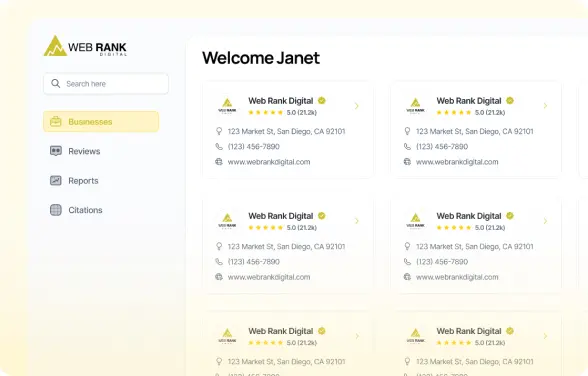
Tools like customer acquisition software can centralise this data so that you see all leads in one dashboard, tagged by location and channel. The site webrankdigital.com, for example, provides exactly this kind of centralised reporting and lead tracking across multiple locations, which is the core capability you need for this step.
What to watch: Attribution gets messy fast. A customer may see a Facebook ad, search for your brand later, and then click a Google ad before calling. Decide on a consistent attribution model (last click, first click, or multi-touch) and stick to it across all locations. Do not let each location use a different model or you will never know which channels really drive results.
Step 4: Create location-specific campaigns from a shared template
Now you start building campaigns. Instead of creating each campaign from scratch, build a master template for each channel. A Google Ads template might include a set of ad groups, keywords, and negative keywords that work for most locations. A social media template could include a post calendar and image guidelines. Each local team then adapts the template by swapping in local images, offers, and location-specific keywords.
This approach saves time and keeps quality high. It also makes it easier to test variations: if one location tries a new headline and sees better click-through rates, you can quickly roll that headline into the template for everyone else.
What to watch: Over-standardisation. If every location runs the exact same ad with only the city name changed, customers will notice the lack of local relevance. Leave room for local flavour: local events, local partnerships, local language. The template should be a starting point, not a straitjacket.
Step 5: Set up a regular review cadence
A repeatable process is not something you build once and forget. You need a rhythm for reviewing performance across locations and updating the system. A weekly 30-minute check on lead volume and cost per lead per location. A monthly deeper dive into which channels are producing the best quality leads. A quarterly review of the entire funnel to see if stages need adjusting.
During these reviews, look for outliers. One location with a much higher cost per lead might have a bidding problem or a bad landing page. One location with a much lower conversion rate might have a sales process issue. The centralised reporting from your customer acquisition software makes these comparisons instant.
What to watch: Don't let the review become a blame session. The goal is to learn and improve, not to punish low performers. Frame every finding as a question: "What can we learn from location A's success?" and "What support does location B need?"
Step 6: Automate the repetitive parts
Once you have a stable process, look for tasks that can be automated without losing quality. Lead routing: automatically assign leads from a specific location to the right sales rep. Follow-up emails: send a standard sequence after a form submission. Ad budget adjustments: pause underperforming ads based on rules you set. Reporting: generate a weekly location performance report without manual work.
Automation frees up your team to focus on strategy and relationship-building, which are harder to scale. But be careful: automation can also hide problems. If an automated email sequence stops sending, you may not notice until leads go cold. Build in alerts and check that your automations are firing correctly.
Step 7: Document everything and make it easy to find
Finally, write down the process. Create a playbook that covers the funnel, the campaign templates, the tracking setup, the review cadence, and the automation rules. Store it somewhere every location can access, like a shared drive or a wiki. Include examples of good campaigns and bad ones. Update it as you learn.
When a new location opens or a new manager joins, they should be able to read the playbook and start executing within days, not months. That is what repeatable really means: the system works even when the people change.
What to watch: Documentation that gathers dust. Assign someone to keep it current. After every quarterly review, update the playbook with new findings. If a step changes, update it the same day.
Scaling without losing local touch
Building a repeatable customer acquisition process across multiple locations is not about turning every store into a clone. It is about creating a reliable engine that delivers leads consistently while leaving room for local intelligence. The best systems combine centralised tools like webrankdigital.com with local insight and regular iteration. Start with your current channels, define a common funnel, track everything, and review often. Automate what you can, document what you learn, and keep improving. Over time, the process itself becomes your competitive advantage.